Chart in practice
Steve Jobs
1955–2011 · Co-founder of Apple
This chart belongs right after Bruce Lee's, because it puts the hardest part of the method on stage: true solar time. Bruce Lee's correction was one minute — honest, but undramatic. This one is twenty-four.
Where the birth data comes from
The date and city are uncontested: February 24, 1955, San Francisco. The birth time is weaker than Bruce Lee's. The 7:15 p.m. figure appears only in astrological databases; mainstream biographies — including Walter Isaacson's — record no birth time at all, and neither does Britannica. A time precise to the minute that circulates exclusively within astrology sources and never once in journalism or biography is itself a signal. So: this piece uses 7:15 p.m., but that figure comes from astrological records rather than a birth certificate we have seen, and everything below inherits that uncertainty. (The frequently repeated claim that he was born at San Francisco General is undocumented, so no hospital is named here.)
The four pillars
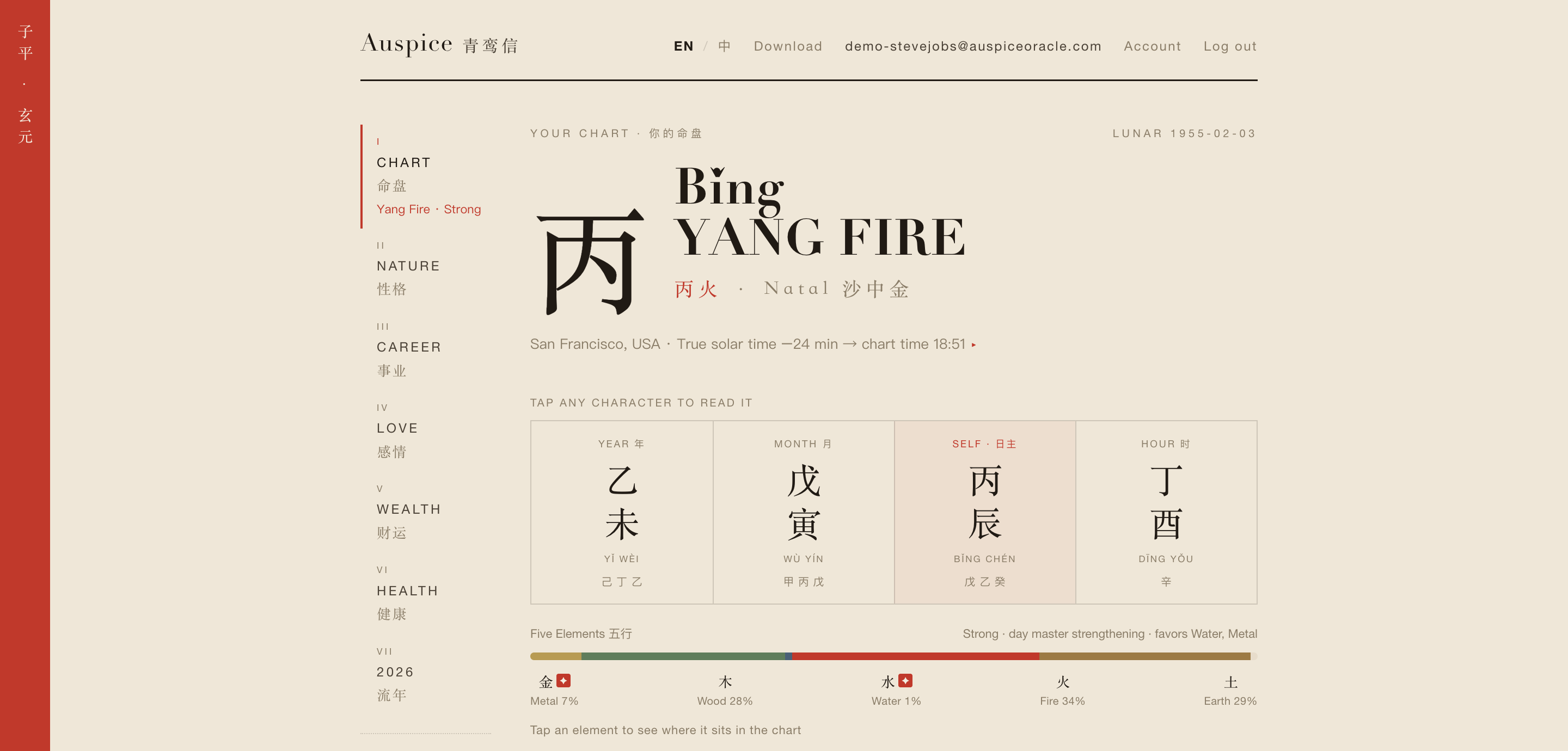
Day Master 丙 · Yang Fire over the Dragon branch; nayin Earth in the Sand. In our naming of the sixty day pillars, 丙辰 is Morning Sun Over the Lake — Bright — and big enough to hold the shadows. That name applies to everyone born on a 丙辰day, roughly one day in sixty. It was assigned before we looked at anyone’s biography.
Clock time is not solar time
| Component | Value |
|---|---|
| Daylight saving | 0 min |
| Longitude | −10 min |
| Equation of time | −14 min |
| Total | −24 min · 19:15 → 18:51 |
7:15 p.m. becomes 6:51 p.m. — twenty-four minutes earlier. Three components, each computed: daylight saving 0 min (not in effect in February 1955), longitude −10 min (San Francisco 122.42°W against the Pacific standard meridian at 120°W), equation of time −14 min (Earth's orbital eccentricity and axial tilt in late February). Clock time is a political convention — time zones were invented for railroads in the 1880s, while BaZi predates them by roughly two thousand years, and the "hour" it refers to is a solar hour. Most free calculators skip this entirely; some apply the longitude offset and stop, quietly dropping an equation-of-time term that swings ±16 minutes across the year. For this chart it changes nothing: 6:51 p.m. sits 9 minutes from the Xū hour boundary, so the hour pillar holds. Our page says so explicitly — a system that only speaks up when the answer is dramatic cannot be trusted.
Five elements
Where the chart fits
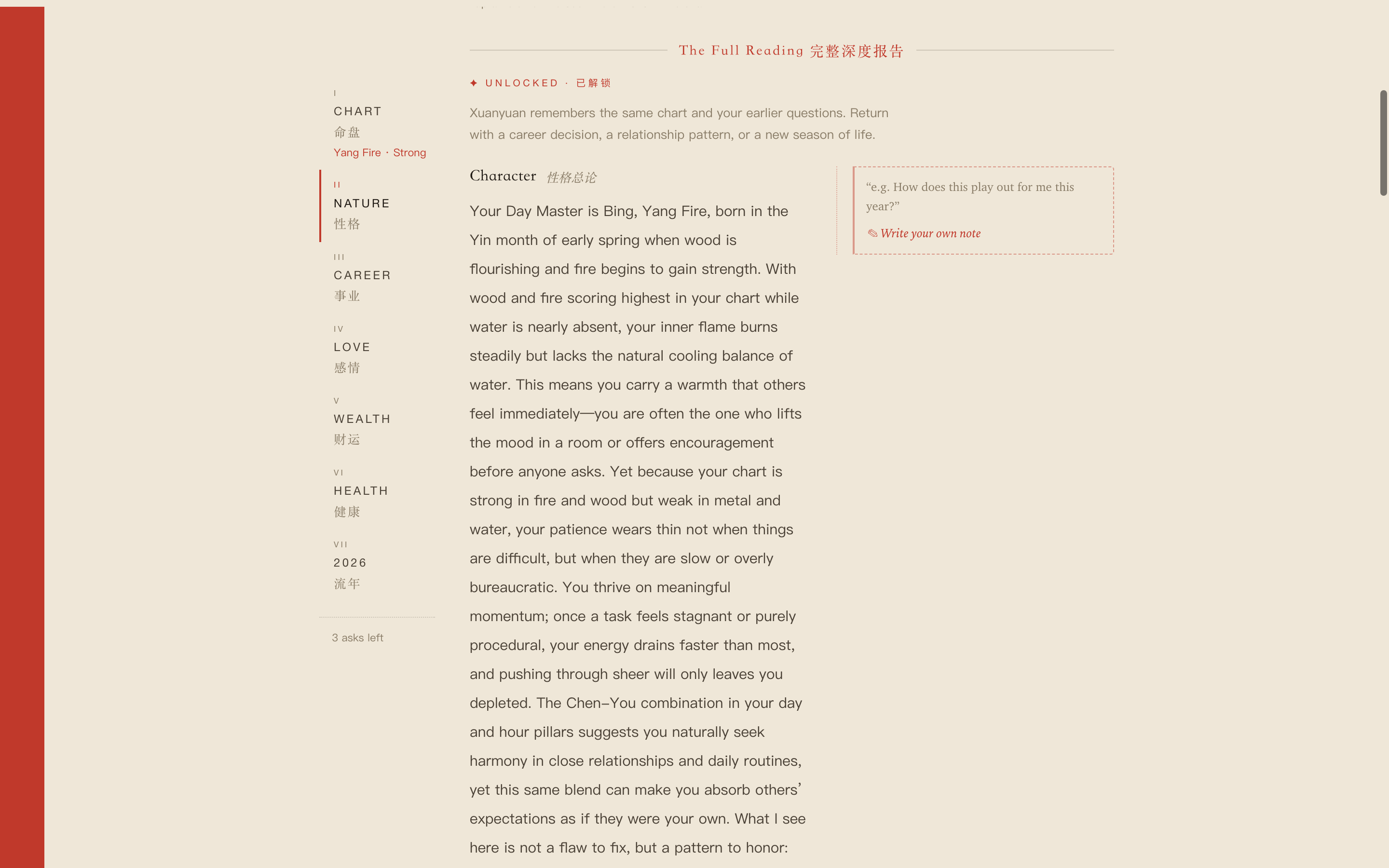
Water: 0.10. The engine's five-element scores: Fire 2.75, Earth 2.35, Wood 2.30, Metal 0.60, Water 0.10. Water is as close to absent as this chart gets. In this system water is what cools fire; read as a Ten God relationship, it governs restraint, structure, and being checked by something outside yourself. A chart this warm with almost no water describes a failure mode that is not lack of drive — it is lack of brakes. The system's own words: "your patience wears thin not when things are difficult, but when they are slow or overly bureaucratic."
The 1985 exit — the mechanism matters more than the shorthand. After the Macintosh underperformed and he lost a power struggle with CEO John Sculley, the board sided with Sculley on May 31 and stripped him of all operational duties, leaving the empty title of chairman — the office he called "Siberia." He resigned that September to found NeXT. (He said at Stanford "I got fired from Apple," which is why everyone repeats it, but the corporate record is more specific: forced out of any real role, then formally resigning. Worth getting right, because losing to a structure rather than to a person is the part that rhymes with a chart holding no water.)
Dropping in, not out. He enrolled at Reed College in autumn 1972, left after roughly one semester, then stayed on campus for about eighteen more months auditing classes — including the calligraphy course taught by Robert Palladino, a former Trappist monk. At Stanford he tied it directly to the Macintosh: "If I had never dropped in on that single course in college, the Mac would have never had multiple typefaces or proportionally spaced fonts." Note what the behaviour actually is: abandoning the procedure of a degree while keeping the substance of the learning. That is the reading's distinction, lived out at nineteen.
The wealth section is the strangest hit. Verbatim: "money tends to flow through your hands as part of active exchange rather than accumulating passively… you are likely more effective at generating income through skilled output, teaching, or creative problem-solving than through speculative holding." Jobs famously took a $1 annual salary as Apple's CEO, and his wealth came overwhelmingly from equity in things he built — notably more from Pixar than from Apple stock. "Income through skilled output rather than speculative holding" is a peculiar way to describe a billionaire, and yet it is the right one.
Where it does not
This is hindsight too, and here it is more dangerous. Jobs's biography is so familiar that almost any reading would find purchase. Reverse it: hand over 乙未 戊寅 丙辰 丁酉 with no name attached, and could anyone tell you this person co-founds the most valuable company on earth? No.
There is no "design" in this chart. Nothing in these eight characters points to typography, industrial design, or computers. The Eating God that appears three times denotes expression and output in general — it cannot distinguish a calligrapher from a chef. If you came hoping the chart would explain the Macintosh, it won't.
We will not touch his illness or death. He died on October 5, 2011, aged 56; the death certificate gives respiratory arrest as the immediate cause with a metastatic pancreatic neuroendocrine tumor underlying — a rarer, slower-growing cancer than the aggressive adenocarcinoma most people mean by "pancreatic cancer." It is documented that after his October 2003 diagnosis he avoided surgery for roughly nine months, operating only in July 2004. We will not go near any of it with a birth chart — and it bears adding that oncologists have publicly cautioned that even the medical question of whether the delay changed his outcome is speculation, since the tumor may already have spread. If the doctors will not claim causation, eight characters certainly cannot.
So what is a chart for
The line our system generated for this chart: "Born of Bing fire in Yin month, your warmth is a steady hearth, not a wildfire." It is a description of a pattern, not a prediction — it belongs to everyone born into that configuration. The honest case for reading a chart was never that it tells you what will happen. It is that it gives you a fixed reference point against which to notice things about yourself you would otherwise rationalise away. For a chart like this one, the useful question is not "will I be successful." It is: where is my water? What actually cools me down — and have I built any of it into my life, or am I running on fire and calling the exhaustion ambition? Jobs needs no birth chart to be explained. But that question is a good one, and you do not need to be Steve Jobs to ask it.
Every number on this page — the pillars, the hidden stems, the element scores, the three-part solar correction — is computed by the same engine that casts reader charts. Cast your own, or read how the time correction works and the charting conventions behind it.
How this series works. We write only about people who have died or whose lives are extensively public; birth data must have a traceable source, and we state how strong that source is. We do not take requests for specific people, we make no claims about the health, marriage, or finances of living individuals, and we never use a chart to reason backwards about anyone’s death. Birth data here is from published records, not confirmed by family or estate. BaZi content is offered for cultural interest and self-reflection — it is not prediction, nor medical, legal, or financial advice.