Chart in practice
Coco Chanel
1883–1971 · French couturière
A woman who retold her origins, her name, and her age left behind one document she could not edit: the birth register of the Saumur poorhouse. This case is cast from that document.
Where the birth data comes from
August 19, 1883, at 4 p.m., in Saumur. Rodden AA — birth certificate in hand. Four in the afternoon, not four in the morning. This is worth stating because the 4 a.m. version circulates widely in French sources, and French Wikipedia carried it until an editor checked the scan of the register, which reads quatre heures du soir — four in the evening. The original is act no. 212, p. 39 of Saumur's 1883 birth register, in the Maine-et-Loire departmental archives. One more thing belongs here: the register misspells her surname as Chasnel. This is not folklore — on the day of registration, the three people who declared the birth were all illiterate and could not sign (Joséphine Pèlerin, an employee of the poorhouse, with her colleagues Sureau and Podestat), and the registrar improvised a spelling by ear. As for the popular claim that she never corrected it because doing so would expose her birth in a charity hospice — that traces to Wikipedia citing Lisa Chaney, and we could not verify it in any biography's text. So we state the misspelling and leave the motive out.
The four pillars
Day Master 乙 · Yin Wood over the Goat branch; nayin Gold in the Sand. In our naming of the sixty day pillars, 乙未 is Tough Grass on the Wasteland — A gentleness that will not die. That name applies to everyone born on a 乙未day, roughly one day in sixty. It was assigned before we looked at anyone’s biography.
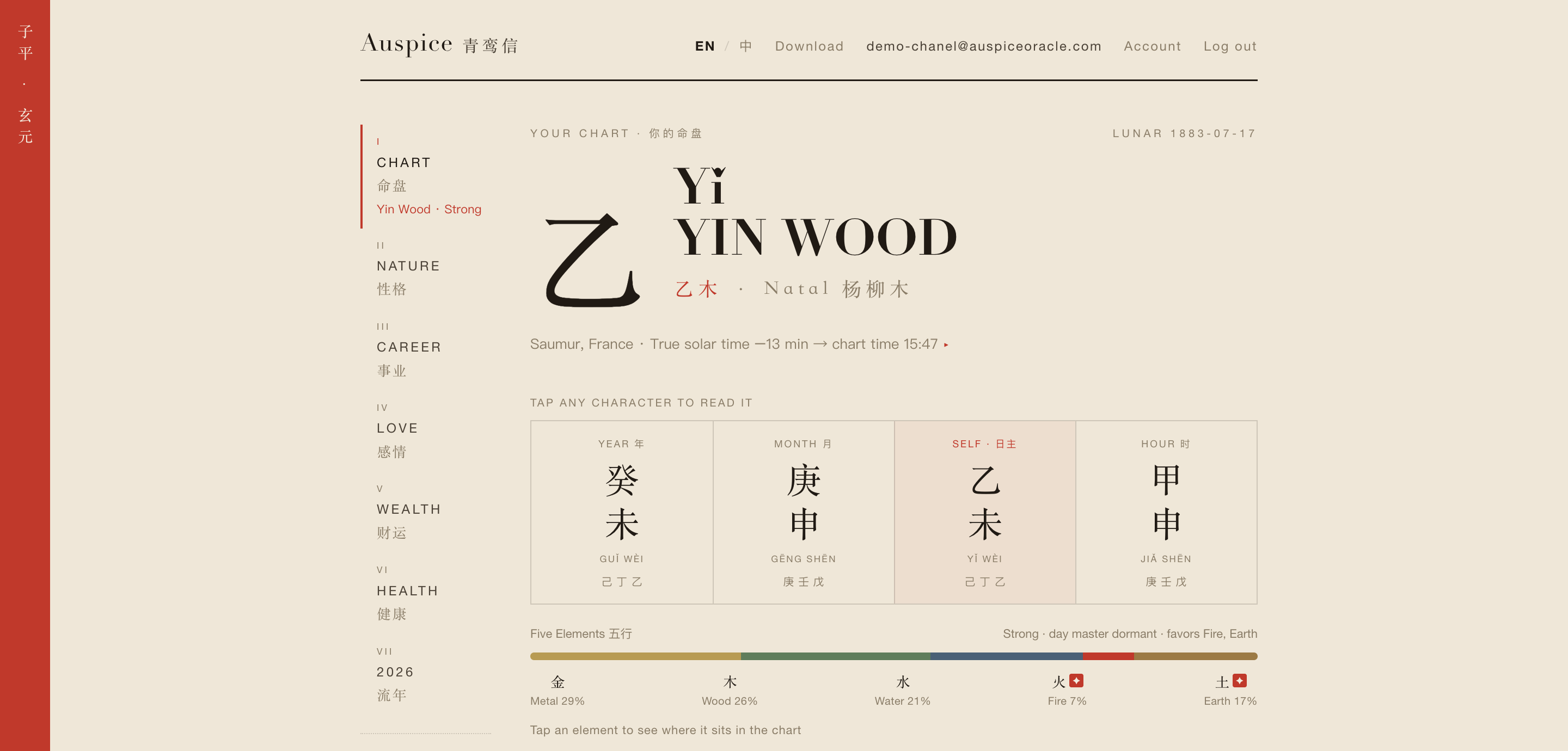
Clock time is not solar time
| Component | Value |
|---|---|
| Daylight saving | 0 min |
| Longitude | −10 min |
| Equation of time | −3 min |
| Total | −13 min · 16:00 → 15:47 |
Yǐ wood born in the Shēn month, when metal rules and wood should be weak — yet this chart is not weak. The engine reads it as strong, and the reasons are on the face of it: wood roots hidden in the Wèi earth of the year and day branches, Jiǎ wood standing beside her in the hour stem, Guǐ water in the year stem feeding the root. A plant the autumn metal should have cut back, holding on. The character worth pausing on is in the month stem: Gēng metal, the Direct Officer, in direct combination with her Yǐ wood. The Direct Officer denotes rules, order, and other people's expectations; a "combination" is not suppression but absorption. The system's phrasing: an innate sense of responsibility that "feels less like external pressure and more like an internal compass." That is checkable against the life. Her mother died on 6 February 1895, aged 31; Gabrielle was 11. Her father placed the daughters in the orphanage at Aubazine, where she spent roughly six years among nuns. The discipline of that place — black and white, plainness, repeatable order — is close to a description of what she later sold to the world.
Five elements
Where the chart fits
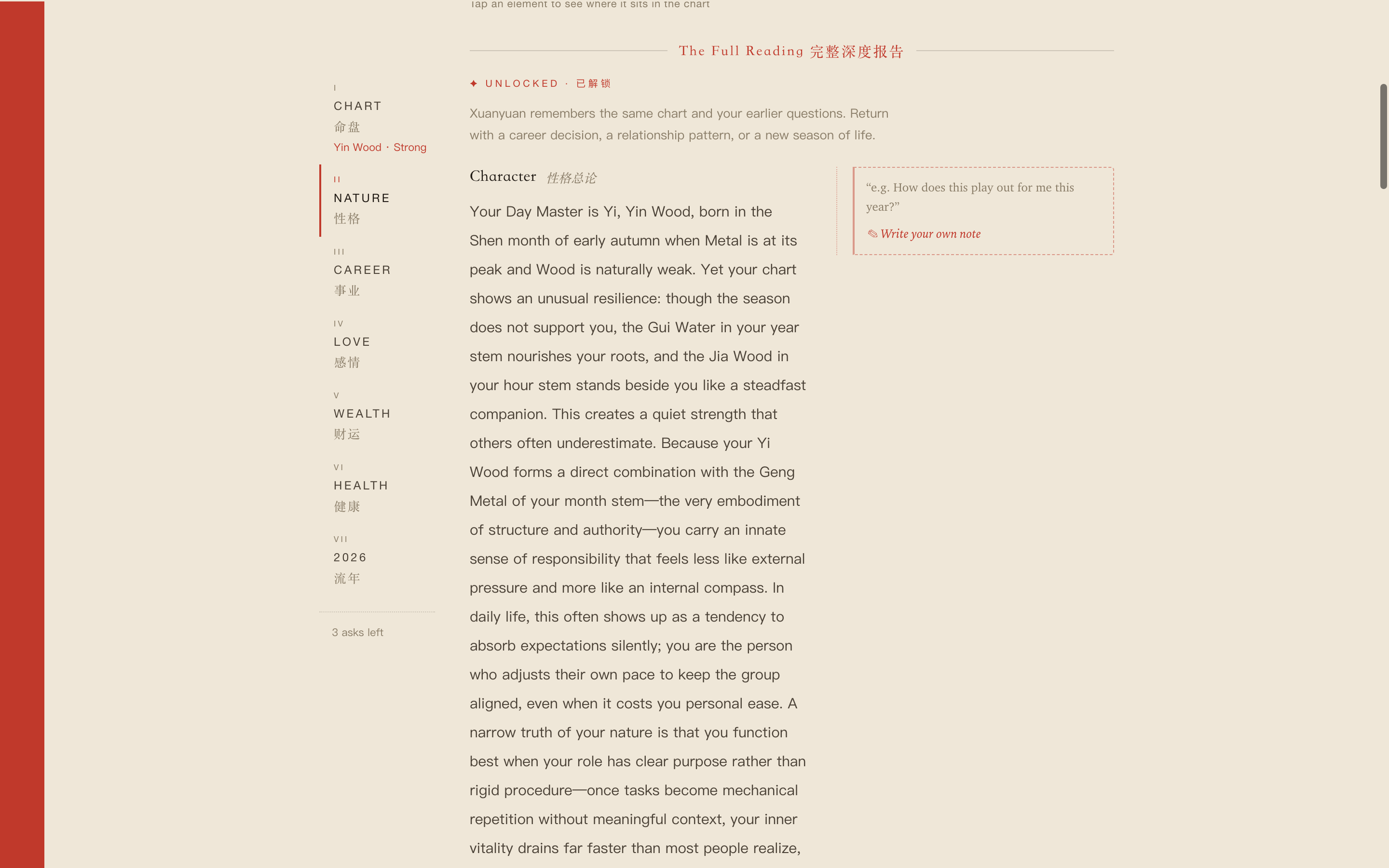
Absorbing the rule rather than obeying it. The reading notes that she would be the one adjusting her own pace to keep a group aligned — a talent for proportion. Proportion is more or less what she sold: jersey, then a cheap fabric associated with underwear and workwear, cut into outerwear with the elaboration stripped out. One caution, because this is usually overstated: she did not invent the little black dress — Vogue's 1926 line about "a Ford signed Chanel" is where the myth starts — and the retreat of the corset was already underway under Poiret. The accurate verb is that she legitimised these things, not that she originated them.
Even "Coco" has more than one origin story, and she told several. The common account traces it to two songs she sang in a Moulins cabaret — Ko Ko Ri Ko and Qui qu'a vu Coco. She herself said her father gave her the name. A third reading connects it to cocotte, a kept woman. Three versions, none settled — which is itself in character for someone who kept rewriting where she came from.
Fire and Earth as the useful elements: an outlet, not endurance. The reading says her wellbeing depends "not on pushing harder, but on creating space for expression and tangible results" — Output to express, Wealth to root. That reads sensibly against a woman who turned convent order into product, and numbered a perfume No. 5 (launched 1921, composed by Ernest Beaux — the story about picking the fifth sample is tradition, not documentation).
Where it does not
There is no "fashion" in this chart. The usual finding: not one of the eight characters points at clothing, design, or aesthetics. The Direct Officer denotes rules — but rules can be a convent's, an army's, or an accounting firm's. The chart describes a relationship to structure, not an occupation.
And the chart cannot read the war years. This has to be stated precisely, separating what is established from what is alleged. Established: her relationship with the German officer Hans Günther von Dincklage (Paris, c. 1941–44); her wartime residence at the Ritz; a May 1941 petition invoking Vichy's antisemitic laws in an attempt to take Parfums Chanel from the Jewish Wertheimer family, which failed; interrogation by the Purge Committee in 1944 and release for lack of evidence; never charged, tried, or convicted. Alleged, not established: the characterisation of her as a Nazi agent, and the agent number attached to it — these come from a French police card recording a suspicion (surfaced by Hal Vaughan in 2011). The card is genuine; what it proves is that someone suspected her, not that a recruitment existed. The two categories must not be merged, and we will not write "Chanel was a Nazi spy" in our own voice. In the other direction, a claim in her favour has also collapsed: the certificate placing her in a Resistance network was shown by historian Guillaume Pollack in 2023 to have been written over whited-out text. None of this is in the chart. That is the point. BaZi describes a pattern in how someone meets rules and order; it cannot tell you what they applied that pattern to. The same instinct for absorbing structure can turn a convent's discipline into couture, or reach for a vicious law to take back a company. The chart does not distinguish between those. People do.
Still hindsight. Given the four pillars with no name attached, no one could derive a fashion empire from them — nor could anyone derive the paragraph above.
So what is a chart for
The line our system generated: "Yi wood embraces Geng metal; your strength is not resistance, but the grace to bend." Read against a woman born in a poorhouse, whose surname the registrar could not spell, it lands with some weight — but it belongs to everyone born on a Yǐ-Wèi day with Gēng in the month stem. It is not a verdict about her. What this case leaves is a harder question: the same pattern, applied to what, is your business and not the chart's. A chart can tell you what shape you are. Where you press that shape is not something eight characters decide.
Every number on this page — the pillars, the hidden stems, the element scores, the three-part solar correction — is computed by the same engine that casts reader charts. Cast your own, or read how the time correction works and the charting conventions behind it.
How this series works. We write only about people who have died or whose lives are extensively public; birth data must have a traceable source, and we state how strong that source is. We do not take requests for specific people, we make no claims about the health, marriage, or finances of living individuals, and we never use a chart to reason backwards about anyone’s death. Birth data here is from published records, not confirmed by family or estate. BaZi content is offered for cultural interest and self-reflection — it is not prediction, nor medical, legal, or financial advice.