Chart in practice
Albert Einstein
1879–1955 · Theoretical physicist
This one is not about how remarkable Einstein's chart is. It is about something more useful: what an honest system does when a chart lands on a boundary. His corrected time sits seven minutes from the hour changing.
Where the birth data comes from
This is the best-sourced birth time in the series, and it deserves saying plainly. For the two earlier subjects the clock time appeared only in astrological databases and in no mainstream biography. Einstein is different: Astro-Databank holds a scan of the actual Geburtsurkunde from the Einstein Archive, reading *"am vierzehnten März des Jahres tausend achthundert siebendzig und neun vormittag um elf ein halb Uhr ein Kind männlichen Geschlechts geboren worden sei"* — on the fourteenth of March 1879, at half past eleven in the morning, a male child was born. Rodden rating AA, from the certificate itself, with no competing time in circulation. For once we are not trusting a citation chain; we are reading the document.
The four pillars
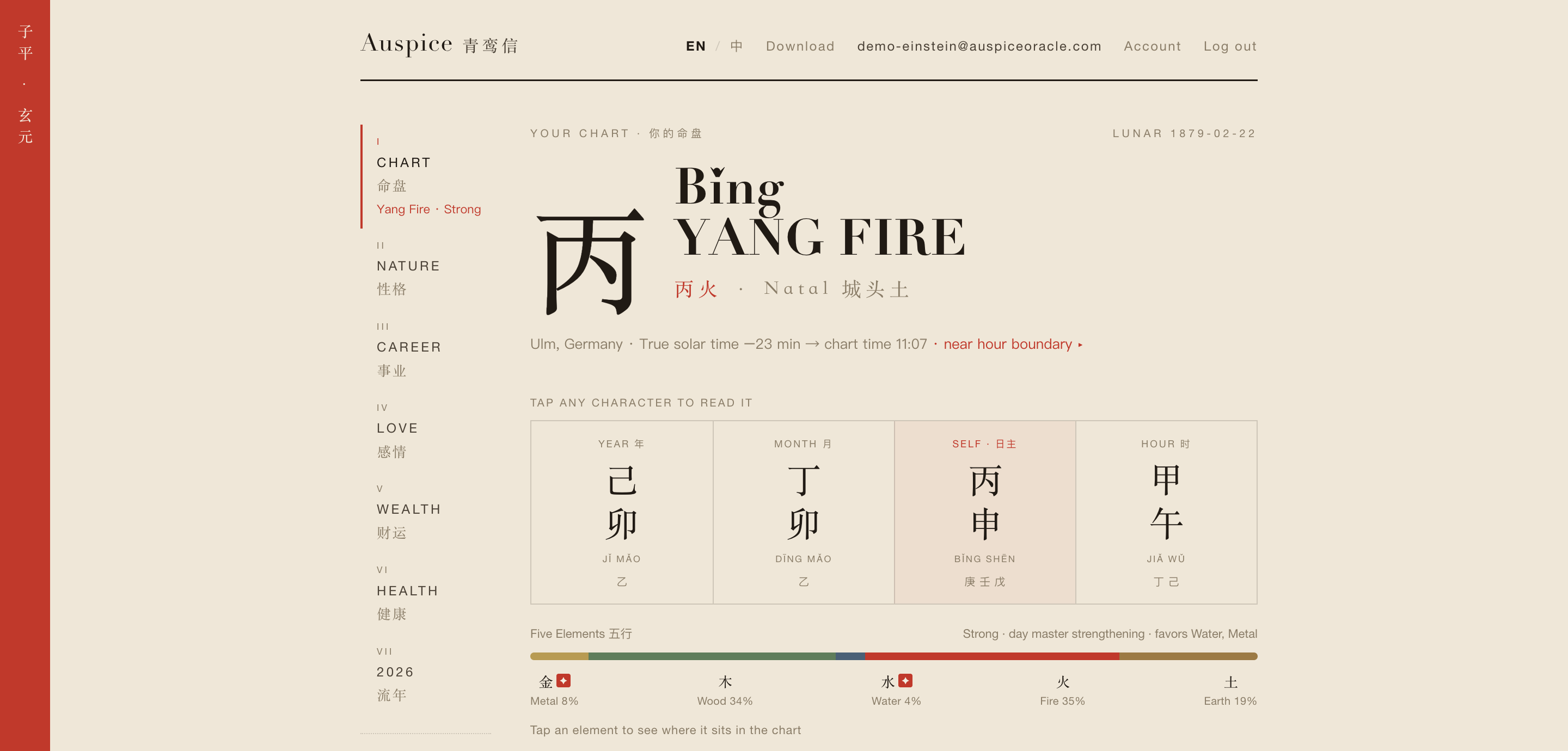
Day Master 丙 · Yang Fire over the Monkey branch; nayin Fire at the Foothill. In our naming of the sixty day pillars, 丙申 is Fierce Sun on Metal and Stone — Meets hardness head-on without losing light. That name applies to everyone born on a 丙申day, roughly one day in sixty. It was assigned before we looked at anyone’s biography.
Clock time is not solar time
| Component | Value |
|---|---|
| Daylight saving | 0 min |
| Longitude | −13 min |
| Equation of time | −10 min |
| Total | −23 min · 11:30 → 11:07 |
The chart time is 11:07 — seven minutes from the next hour branch. The three components are each checkable: daylight saving 0 min (no such thing existed in 1879), longitude −13 min (Ulm at 9.99°E against its zone's standard meridian), equation of time −10 min (Earth's orbital correction in mid-March), for a total of −23 min. And 11:07 falls right at the start of the Wǔ hour (11:00–13:00). The engine flags this as a boundary case and the page says so out loud. That is not a defect; it is the design. A system worth trusting when it is uncertain is one that speaks up while it still is. So what do those seven minutes actually threaten? Recast eight minutes earlier and the answer is: the hour pillar changes from Jiǎ-Wǔ to Guǐ-Sì — and nothing else. Year, month, day, Day Master, and the strength verdict all hold. In other words, exactly one of the four pillars is conditional here; the other six characters stand.
Five elements
Where the chart fits
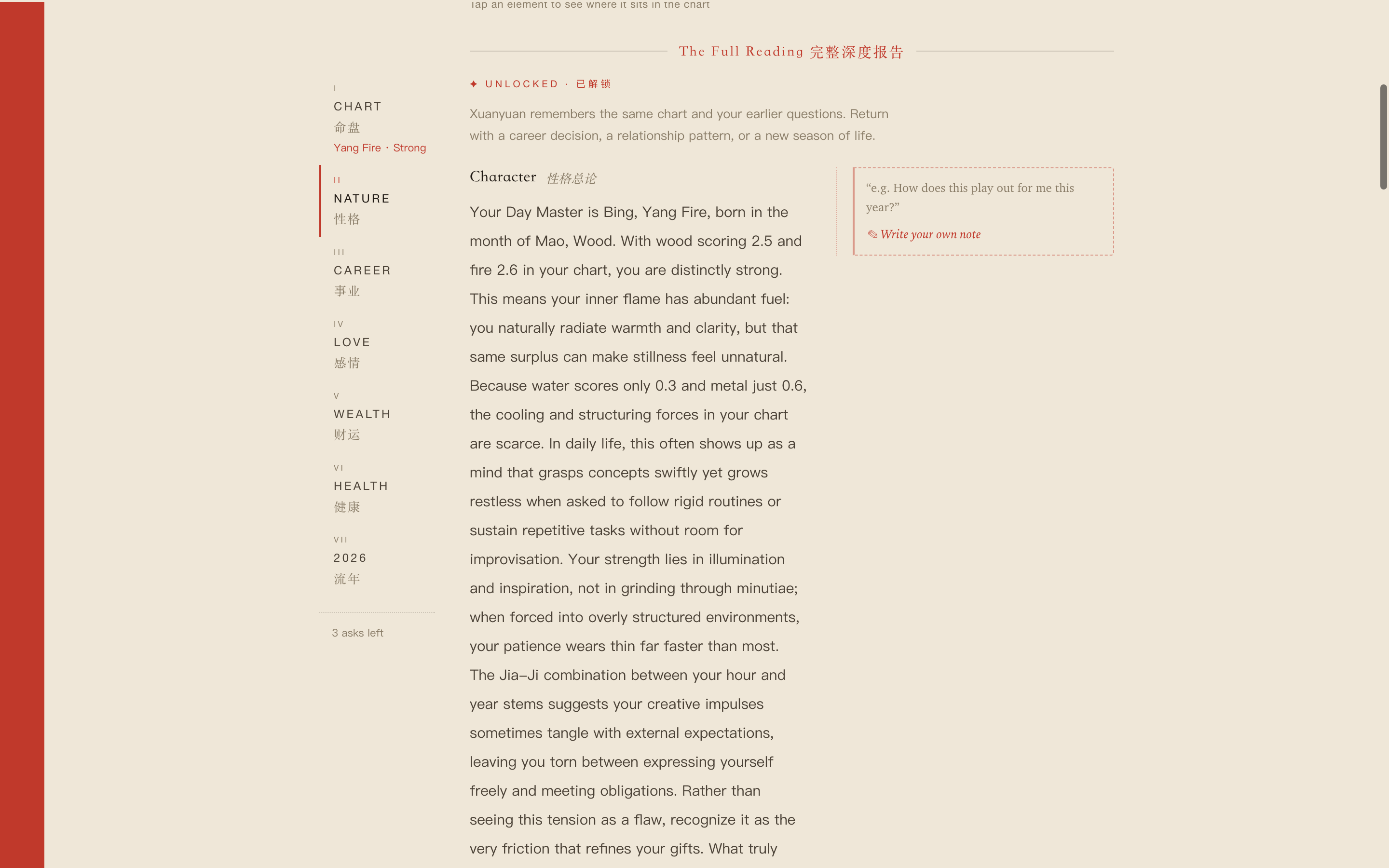
Too much input, not too little. The system's own words: wood feeding fire, with the hour pillar adding still more fuel — "your inner flame has abundant fuel." Then the useful part: with water at 0.3 and metal at 0.6, the cooling and structuring forces are scarce. The Resource star governs learning and absorption. Whatever this chart's difficulty is, a shortage of fuel was never it.
Held by structure rather than lit by inspiration. The reading says his strength lies in illumination, not in grinding through minutiae, and that he needs channels and boundaries rather than more fuel. Put that next to a man who took a post as Technical Expert, Class III at the Swiss Patent Office in Bern in June 1902 (promoted to Class II in 1906) and stayed at that desk until October 1909 — and who wrote the four 1905 Annalen der Physik papers while sitting at it.
One correction worth making in passing. "Einstein failed math" is among the most durable false facts in circulation. He never failed mathematics and never repeated a year — his 1896 Aarau Matura shows 6/6 in algebra, geometry, and physics on a scale where 6 was the top mark. The real kernel: in October 1895, aged 16 and two years under the admission age, he sat the Zurich Polytechnic entrance exam, excelled in the mathematics and physics sections, and failed the non-science ones — French and the literary-historical papers. The myth comes from Aarau having inverted its grading scale that year (1-best became 6-best), and later readers misreading the table.
Where it does not
There is no "physics" in this chart. Same finding as the two earlier cases, and here it is starker: not one of the eight characters points at mathematics, physics, or any specific discipline. The Resource star denotes learning, but it cannot distinguish a physicist from a theologian. Bǐng fire denotes illumination and expression, not derivation. If a chart could be quietly fitted to a life after the fact, this is exactly where it would show — and it doesn't.
It is still hindsight. Reverse the order: hand over the four pillars with no name attached, and could anyone tell you this person rewrites physics? No. And this case needs the disclaimer more than the previous two, not less — because a birth certificate in hand makes it tempting to think that hard data implies hard conclusions. The strength of the source guarantees only that the chart is cast correctly. It says nothing about whether a chart can explain a person.
And the seven minutes remain. The hour pillar is the conditional one, and the hour pillar is conventionally read for later life and for children. Any claim resting on it can only be stated as "if the recorded minute is exact, then…" We leave that sentence standing rather than quietly picking whichever version reads better.
So what is a chart for
The line our system generated: "Bing fire, born in Mao month: your warmth is innate, yet boundaries define your true light." A description of a pattern, not a prediction — it belongs to everyone born into that configuration. What is worth taking from this case is not Einstein's chart but those seven minutes. A system that speaks up where it is uncertain is worth more than one that is eloquent where it is safe. The same applies to your own chart: if your birth time sits near an hour boundary, you should be told so, rather than handed a chart that pretends the question never came up.
Every number on this page — the pillars, the hidden stems, the element scores, the three-part solar correction — is computed by the same engine that casts reader charts. Cast your own, or read how the time correction works and the charting conventions behind it.
How this series works. We write only about people who have died or whose lives are extensively public; birth data must have a traceable source, and we state how strong that source is. We do not take requests for specific people, we make no claims about the health, marriage, or finances of living individuals, and we never use a chart to reason backwards about anyone’s death. Birth data here is from published records, not confirmed by family or estate. BaZi content is offered for cultural interest and self-reflection — it is not prediction, nor medical, legal, or financial advice.