Chart in practice
Frida Kahlo
1907–1954 · Mexican painter
The hook here is not in the chart but in the archive: Frida Kahlo told the world she was born in 1910, so that her birth would coincide with the Mexican Revolution. The civil register says 1907. A case where the person's own account and the document disagree — and a BaZi chart can only be cast from one of them.
Where the birth data comes from
July 6, 1907, at 8:30 a.m., in Coyoacán — then a separate municipality within Mexico's Federal District, not absorbed as a borough until 1928. Rodden AA: the time first came through Hayden Herrera's biography Frida, and was later upgraded when researcher Sy Scholfield produced the birth registry entry from the Distrito Federal archives. One widely repeated detail worth correcting in passing: she was not born in the Casa Azul — the records point to her grandmother's house.
The four pillars
Day Master 丙 · Yang Fire over the Dragon branch; nayin Earth in the Sand. In our naming of the sixty day pillars, 丙辰 is Morning Sun Over the Lake — Bright — and big enough to hold the shadows. That name applies to everyone born on a 丙辰day, roughly one day in sixty. It was assigned before we looked at anyone’s biography.
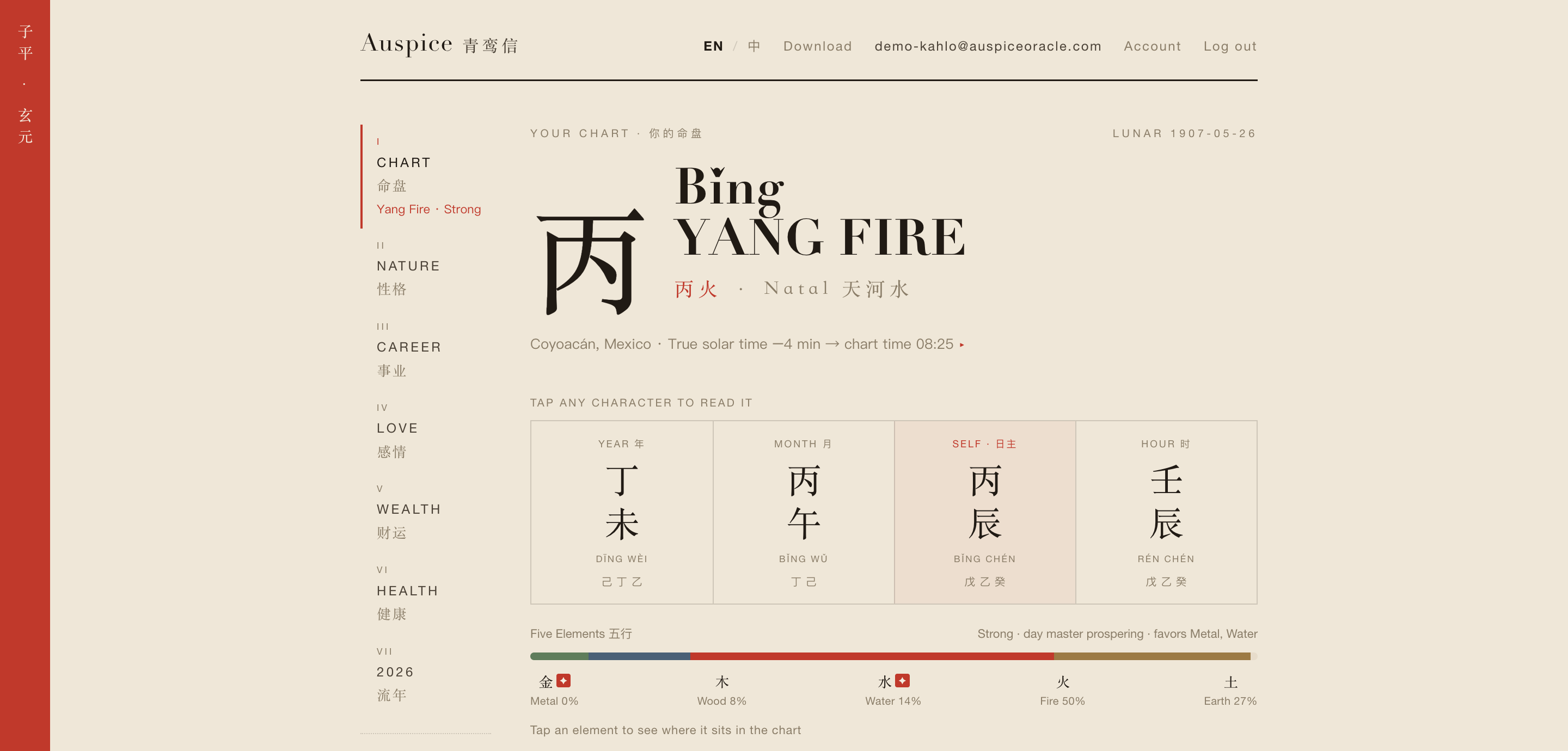
Clock time is not solar time
| Component | Value |
|---|---|
| Daylight saving | 0 min |
| Longitude | 0 min |
| Equation of time | −4 min |
| Total | −4 min · 08:30 → 08:25 |
The two years produce two unrelated charts. Cast from July 6, 1907, the pillars are Dīng-Wèi, Bǐng-Wǔ, Bǐng-Chén, Rén-Chén, with a Bǐng Fire Day Master. Cast from the 1910 she claimed, the year, month, and day pillars all change and the Day Master is no longer Bǐng Fire. This is not a three-year discrepancy — it is a different person. Which is exactly why this series insists that birth data have a traceable source. If even the subject's own account can be part of the story she is telling, then a chart's credibility is capped by the credibility of the record. We use the register's version because it is a document. She used 1910 because that was the story she wanted. Both are real; they simply cannot be mixed. (The motive usually given — aligning her birth with the Revolution — is Herrera's reading, hardened by repetition. The year is documented; the motive is inference. We keep the two apart.)
Five elements
Where the chart fits
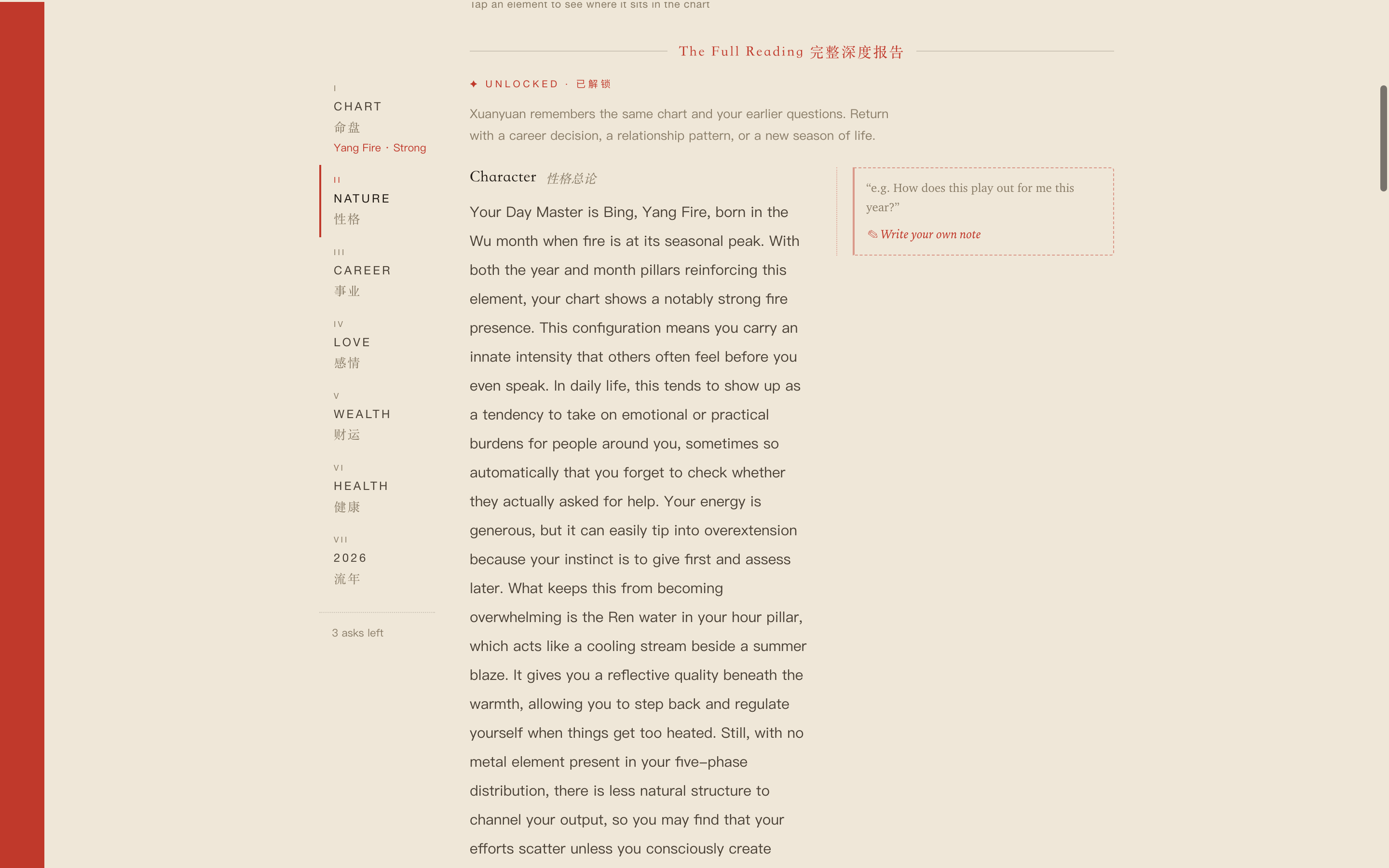
Fire 50%, Metal 0%. The system's words: fire at its seasonal peak, an intensity "others often feel before you even speak," with a tendency to take on other people's burdens "so automatically that you forget to check whether they actually asked." What tempers it is the Rén water in the hour pillar — "like a cooling stream beside a summer blaze." And it names the gap directly: with no metal present, there is less natural structure to channel the output.
The impulse to fix things arrives before the judgement does. On 17 September 1925, aged 18, the wooden bus she was riding was struck by an electric streetcar: a handrail through the pelvis, the spine broken in three places, the right leg fractured in eleven, plus collarbone, ribs, shoulder, and foot. She began to paint during the recovery — her father supplied the paints, her mother had an easel built to fit over the bed, and a mirror was fixed above the canopy. She painted herself first because she was the only model she could see.
The illness at six, and a better-documented one alongside it. Polio in 1913 left her right leg thinner and shorter. Worth stating together with it: her own physician, Leo Eloesser, documented spina bifida on her X-rays — a finding with a contemporaneous clinical basis, unlike the retrospective diagnoses that usually attach to famous patients.
Where it does not
There is no "painting" in this chart. The Output star is there, hidden in the Chén earth of the day and hour branches, and the reading names it. But Output cannot distinguish a painter from an orator, a cook from a composer. Not one of the eight characters points at painting. If you came hoping a chart could tell you someone would pick up a brush, this one cannot.
"Metal 0%" is a striking number — treat it carefully. An element that is entirely absent looks like a key, which is precisely why it is the easiest thing here to overuse. The figure comes from the engine's fixed weighting, published on the charting-method page; it describes the composition of these eight characters, not a verdict on a life. The same zero belongs to everyone born into this configuration.
We will not touch her death. She died on 13 July 1954, aged 47. The official cause was pulmonary embolism; there was no autopsy, and she was cremated within hours. Whether it was suicide remains open — the final diary line is a farewell, not a note, and the frequently cited pill count comes from secondary reporting. We will not use a birth chart to argue any side of that question. No auspicious-or-inauspicious verdicts about the dead; there is no exception to this one.
So what is a chart for
The line our system generated: "Born in Wu month, your Bing fire is tempered by Ren water — your strength lies in restraint." It belongs to everyone born into that configuration; it is not a forecast. What this case leaves behind is not the question of what "Metal 0%" means, but which birth record you use. Frida gave the world 1910; the archive gives us 1907. Two charts, only one of which can be cast. The same holds for your own: whether a reading is worth anything begins not with the interpretation but with whether the numbers you handed over were true.
Every number on this page — the pillars, the hidden stems, the element scores, the three-part solar correction — is computed by the same engine that casts reader charts. Cast your own, or read how the time correction works and the charting conventions behind it.
How this series works. We write only about people who have died or whose lives are extensively public; birth data must have a traceable source, and we state how strong that source is. We do not take requests for specific people, we make no claims about the health, marriage, or finances of living individuals, and we never use a chart to reason backwards about anyone’s death. Birth data here is from published records, not confirmed by family or estate. BaZi content is offered for cultural interest and self-reflection — it is not prediction, nor medical, legal, or financial advice.