Chart in practice
Bruce Lee
1940–1973 · Martial artist, actor, founder of Jeet Kune Do
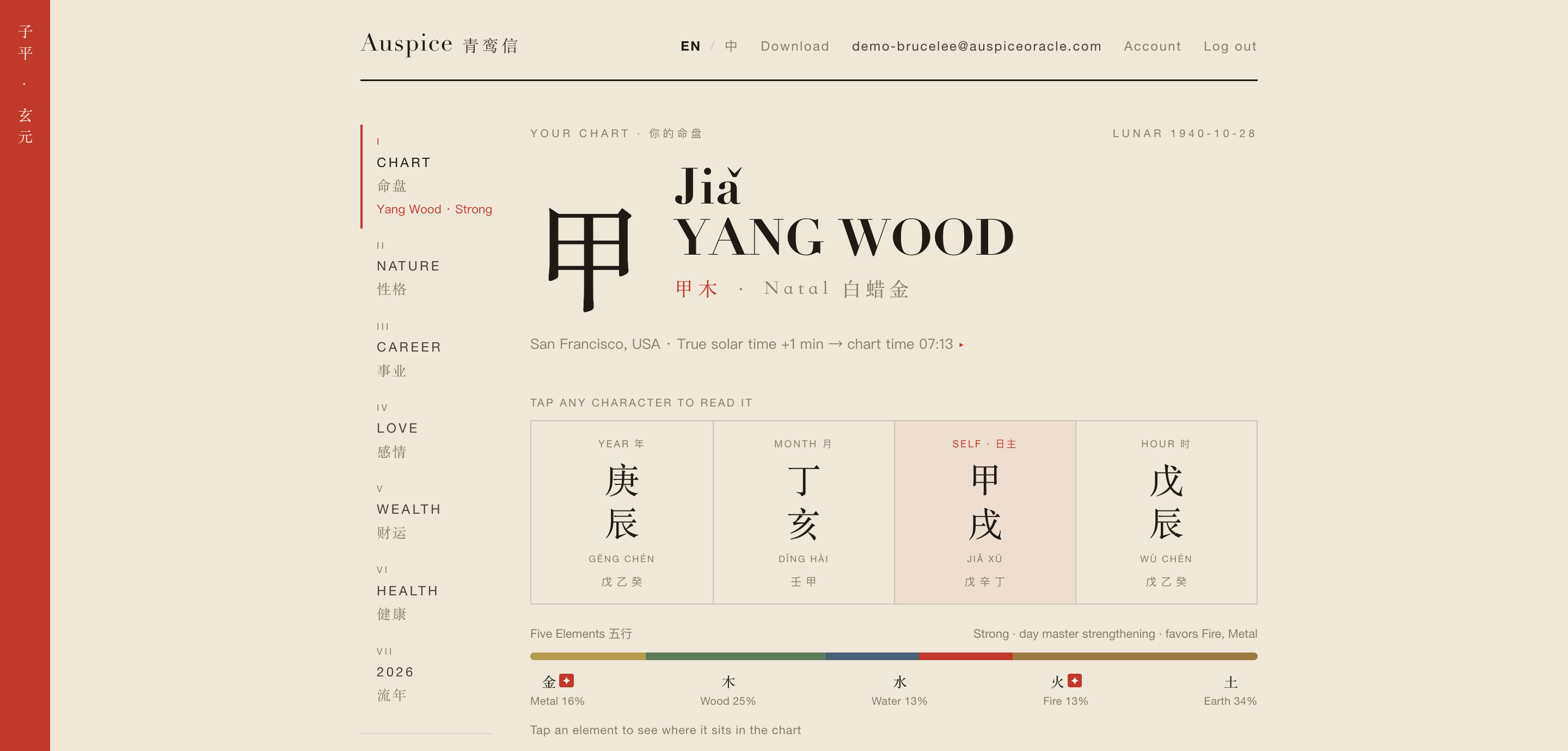
A BaZi chart needs four pillars, and the hour pillar needs a clock time. Most public figures left only a date, which means no complete chart — Bruce Lee is one of the few exceptions with a traceable claim, which is why this series starts with him.
Where the birth data comes from
Date, hospital, and city are uncontested public record: November 27, 1940, at the Chinese Hospital in San Francisco Chinatown (845 Jackson Street; a commemorative plaque was installed in 1998). The clock time needs a caveat. The 7:12 a.m. figure comes from the astrological database Astro-Databank, which marks it as birth-record sourced. Wikipedia, Britannica, and Bruce Lee's official site all give the date with no time at all. So there is one source and a lot of downstream copies, and we cannot independently verify the record itself. We use it because it falls mid-way through the Chén hour, consistent with the well-known "born in the hour of the Dragon" claim below — but you should know it is sourced, not settled.
The four pillars
Day Master 甲 · Yang Wood over the Dog branch; nayin Hilltop Fire. In our naming of the sixty day pillars, 甲戌 is Lone Tree on the Autumn Plain — A landscape unto itself — no forest required. That name applies to everyone born on a 甲戌day, roughly one day in sixty. It was assigned before we looked at anyone’s biography.
Clock time is not solar time
| Component | Value |
|---|---|
| Daylight saving | 0 min |
| Longitude | −10 min |
| Equation of time | +11 min |
| Total | +1 min · 07:12 → 07:13 |
The year branch is Chén, and so is the hour branch. Chén is the Dragon — he was born in 1940, a Gēng-Chén (Dragon) year, and 7:12 a.m. falls in the Chén (Dragon) double-hour. "Born in both the year and the hour of the Dragon" appears throughout his biographies and is the accepted explanation for his Chinese stage name, 李小龍, "Lee the Little Dragon." This is not something we discovered; it is a long-circulated claim that the chart simply confirms. You do not have to trust our reading — you can check those two characters yourself.
Five elements
Where the chart fits
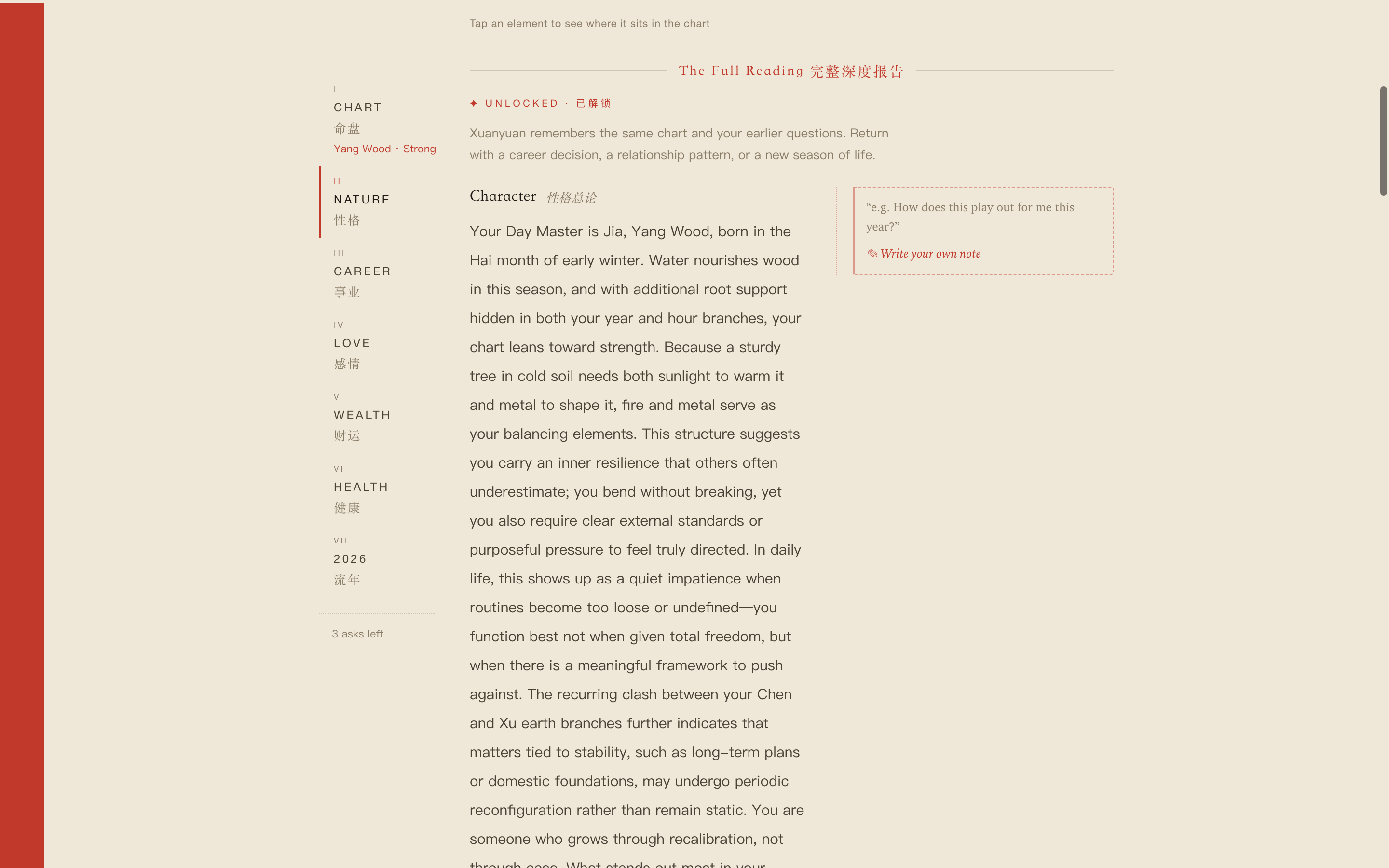
A deep-rooted tree planted in ground that keeps turning over. That phrase is verbatim system output, and it is the key to the chart. The Wood Day Master runs strong (born in the Hài month, where water feeds wood), but Earth runs heavier — Chén in both year and hour, Xū beneath the day, with Indirect Wealth appearing four times across stems and hidden stems, plus two Chén–Xū clashes and a Chén–Chén self-punishment. Earth is this chart's wealth element, and there is a lot of it, in motion: not settled abundance, abundance in upheaval.
A transpacific uprooting at eighteen. In April 1959 he left Hong Kong for the United States and his older sister Agnes; street fighting was genuinely a factor, alongside claiming U.S. citizenship at eighteen. (One popular version — that he beat a triad boss's son and had a contract taken out on him — is disputed: biographer Matthew Polly reports that Lee's own siblings denied the triad element. We don't use it.)
Levelling up inside one field rather than switching fields. The career section reads: "rather than switching lanes frequently, upgrade your role within the same domain." That is close to a description of what he did — student, then instructor, then founder of his own school (Jeet Kune Do, 1967), then the person who carried Chinese martial arts into Hollywood. He never left martial arts for something else.
Where it does not
This is hindsight. I know the life, then read the chart, so of course I find the parts that match — that is a property of human beings, not evidence about charts. Reverse it: hand me 庚辰 丁亥 甲戌 戊辰 with no name attached, and could I tell you this person becomes an international film and martial-arts icon? No. No BaZi system can do that. Charts describe patterns, not events; dispositions, not résumés.
There is no "martial" in this chart. This is the counterintuitive part. In the chart of one of the most famous fighters who ever lived, not one of the eight characters points at combat. Seven Killings (庚 Metal) denotes authority, discipline, and pressure — not fighting. Jiǎ Wood denotes growth and upward reach — not aggression. If you came hoping the chart would explain the fighter, it will disappoint you — which is precisely the evidence that it is not being fitted after the fact.
We will not touch his death. He died on July 20, 1973, in Kowloon, Hong Kong, aged 32. The 1973 inquest returned "death by misadventure" — cerebral edema attributed to a reaction to the painkiller Equagesic. Later decades produced further hypotheses, including heatstroke and, in a 2022 peer-reviewed paper, hyponatremia — all of these are hypotheses, not settled findings. We will not use his chart to reason backwards about any of it. The rule is simple: no auspicious-or-inauspicious verdicts about the dead. Using a chart to retroactively "explain" someone's death is the cheapest and least decent move available in this field.
So what is a chart for
The line our system generated for this chart: "Jiǎ Wood sits on Xū Earth, cracking open the wealth vault — your footing is not in stability, but in taking root amid upheaval." It fits him, but it is not a prediction. It is a description of a pattern, and it applies equally to everyone born on a Jiǎ-Xū day with those clashes — one day in every sixty, tens of millions of people. The use of a chart was never to tell you what will happen. It is to give you a fixed reference point for looking at what already has. Bruce Lee's life needs no chart to explain it. But a chart lets a reader ask a different question: is my own ground moving? Am I the kind of person who cannot grow in stability, who only roots deeply when things shake? That question is worth more than any forecast.
Every number on this page — the pillars, the hidden stems, the element scores, the three-part solar correction — is computed by the same engine that casts reader charts. Cast your own, or read how the time correction works and the charting conventions behind it.
How this series works. We write only about people who have died or whose lives are extensively public; birth data must have a traceable source, and we state how strong that source is. We do not take requests for specific people, we make no claims about the health, marriage, or finances of living individuals, and we never use a chart to reason backwards about anyone’s death. Birth data here is from published records, not confirmed by family or estate. BaZi content is offered for cultural interest and self-reflection — it is not prediction, nor medical, legal, or financial advice.